
Alumni profile: Martin Wolf on a career shaped by curiosity
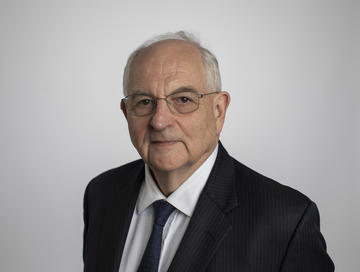
For more than three decades, Martin Wolf has occupied one of the most influential seats in economic journalism. As Chief Economics Commentator at the Financial Times, he has spent his career trying to make sense of a changing global economy and explaining it to readers around the world.
Yet journalism was never part of the plan. In fact, Martin says there was never much of a plan at all.
“I never had a plan,” he says. “There was no life plan for me. It was a series of accidents.”
Martin's route into economics was itself an unexpected one. He matriculated at Corpus Christi College in 1965 to study Classics, completing Honour Moderations in Hilary term 1967. But his growing interest in politics and public life led him to change direction.
Active in student politics during the turbulent politics of the 1960s, Martin believed that understanding economics was essential if he was to understand the political questions unfolding around him.
“I wanted to understand economics, because I felt that I couldn't understand politics, and I couldn't understand what was going on around me if I didn't have some grasp of economics,” he recalls.
In Trinity term 1967, he switched to Philosophy, Politics and Economics. At the time, students took eight papers across all three subjects; Martin chose the maximum four papers available in economics, before taking his Finals in Trinity term 1969. He then moved to Nuffield College as a postgraduate student, completing what was then the BPhil in 1971.
The decision to abandon Classics for economics was, he admits, something of a gamble. Martin had barely studied mathematics since the age of 15 and had no certainty that the new subject would suit him.
Economics, he says, gave him what he had been looking for: “a window on the world”.
“It provided me with a window on how the world works, and therefore on what I was interested in: how the world works, and how politics in particular, and public life works, which I don't think I could have got in any other way.”
Among his undergraduate papers, statistics proved an unexpected revelation. He found that he both enjoyed it and was good at it, later describing it as “the single most important paper I took”.
But Martin's relationship with economics was never principally about technical specialisation. Even early in his career, he came to see the discipline as a means of answering broader questions about societies and public life.
“Economics, to me, is a tool for understanding the world,” he says. “It's not something I'm, as it were, interested in for itself.”
From Oxford to the World Bank
After Nuffield, Martin faced a choice. An academic career was available to him - he was offered a temporary lectureship at Merton College - but he had already concluded that it was not where his strengths or interests lay.
Speaking candidly, he did not believe he had the mathematical training to become the kind of economist he saw the discipline increasingly rewarding, but there was a more fundamental consideration too.
“I came to realise that my talents are real but I'm not really fundamentally original,” he says.
The economists he most admired were those capable of producing genuinely new ideas which changed how others understood the discipline. Martin instead wanted to take his own abilities out into the world: to understand events, engage with them and, where possible, contribute to public policy.
He joined the World Bank as a Young Professional immediately after leaving Nuffield in 1971 and rose quickly to become a Senior Economist.
Development presented exactly the kind of real-world economic challenge he was seeking.
“I thought I might make a difference, and at least I'd learn a lot,” he says. “And I don't think I made much of a difference, but I learned a lot.”
Working alongside economists and colleagues from around the world dramatically broadened his understanding. During the 1970s he spent a significant period working on India, eventually becoming Senior Economist in the World Bank’s India Division during a period that included oil shocks and serious economic pressures.
Martin believes the Bank’s work contributed to stabilising the country and, perhaps, to the beginnings of a shift towards a more open Indian economy.
His growing interest in international trade subsequently took him to the Trade Policy Research Centre, a London-based think tank, in 1981. He spent six years there, eventually serving as Director of Studies and working on international trade and global negotiations.
When the funding came to an end, a new and unexpected opportunity emerged.
An offer “out of the blue”
In 1987, aged 40 and with no background in journalism, Martin was approached by the then editor of the Financial Times and invited to become its chief lead writer on economics.
“I never planned to be a journalist,” he says. “It never occurred to me.”
Faced with the opportunity, his calculation was straightforward: “The offer came, and I thought, that sounds fun. It sounds interesting. I should take it. And if it's a disaster, it's a disaster, but maybe it won't be.”
It wasn't.
Martin joined the FT in September 1987 and has remained there ever since. In January 1996, he became Chief Economics Commentator, the position he continues to hold today.
The role, he says, has given him an extraordinary platform from which to do what first attracted him to economics at Oxford: understand what is happening in the world and help other people understand it too.
“My job is to clarify things for people, explain what's going on, and argue the things I believe in, and explain what I've learned in the process,” he says.
For someone whose curiosity has always extended well beyond a single branch of economics, the breadth of the job has been particularly important.
“The beauty of what I've been able to do is I can do that on an unlimited range of topics. And that satisfies my curiosity and natural broad range of interests. I don't want to specialise in one thing.”
Martin is reluctant to make grand claims about the impact of his work. Whether decades of economic commentary have influenced events in any measurable way is, he says, impossible to know. Instead, he sees the value of the job in something more fundamental: helping people make sense of the societies in which they live.
He describes himself as “somebody teaching the world - well, it's a small part of the world, but nonetheless, a significant part of the world - about what's going on.
“I think it's one of the important things free societies and democratic societies need. It is a role that has to be played by some people, and I've been very happy to play it.”
“Do things that excite you”
Ask Martin what advice he would give an Oxford student considering economics today, and he initially resists the premise.
The rapid development of artificial intelligence makes him cautious about predicting what careers will look like for the generation now entering university. Even the kind of journalistic career he has enjoyed may not exist in the same form in future.
But after 55 years of working life, there is one principle he is willing to offer.
“If you have the opportunity, do things that excite you, intrigue you, and keep doing things that excite and intrigue you.”
It's a philosophy that makes sense of his own unconventional career: the Classics student who took a chance on economics; the aspiring economist who decided academia was not for him; the development economist who moved into trade policy; and the 40-year-old who accepted an unexpected invitation to become a journalist.
“You do things better if you're interested in them than if they bore you silly,” he says. “I've been working now for 55 years, which is quite a long career, and the great advantage is I'm still excited by what I'm writing about, because it always changes.”
He remembers discussing the question with his father in the 1970s. His conclusion then remains his conclusion now: if fortunate enough to have a genuine choice between work that pays vastly more and work that is genuinely enjoyable, choose the latter.
Martin considered moving into financial markets more than once during his career. He never did.
“I have never regretted not doing that, because it wouldn't have interested me, and this interests me.
“Live your life, your only life - you'll not be given another one - with excitement, if you possibly can. The really important things in life are to love people and love what you do. Absolutely. Nothing else is as important.”
A life changed by Oxford
More than half a century after leaving Oxford, Martin has little difficulty identifying what mattered most about his time at the University.
The first has nothing to do with economics.
At the beginning of his third year, he met a first-year student who would become his wife. They have since had three children and six grandchildren.
“Nothing else, obviously, compares,” he says.
Next come the friendships, including many formed among economists at Nuffield which endured throughout his life.
And then there was Oxford's intellectual environment.
Martin recalls being surrounded by talented fellow students and being taught by economists who had a lasting influence on him, including Ian Little, Peter Oppenheimer and Nobel laureate John Hicks.
What stood out to Martin was the breadth of their thinking. They saw economics not simply as a technical subject, but as a way of understanding society and how people behave.
They were engaged in economics, Martin says, because they saw it - as he believes it should still be taught - “in the broadest sense, a political science. A science of human life, of society.”
Being surrounded as a young man by talented contemporaries and teachers committed to challenging ideas and forcing students to clarify their thinking was, he says, “an immense privilege”.
Martin still returns to Oxford regularly and recently spoke to the Oxford Economics Society about the world economy. Much has inevitably changed since he matriculated in 1965, but one thing, he thinks, has not.
“The young people are the same. In some sense, intelligent, enthusiastic, 18, 19, 20-year-olds. They're always the same.”
Looking back, Oxford sits alongside his family among the great pieces of good fortune in his life.
“Oxford changed my life entirely and unambiguously,” he says. “For the better.”

